Tuesday, 1 September 2015

The Marketer’s Guide to Periscope

Everyone and their mom knows that Periscope is becoming more and more popular. In fact, according to TechCrunch, over a million people signed into the app in the first 10 days after the launch on March 26.

That’s just incredible!

Want to know the best part?

Periscope still “fresh”, and you (as a marketer) have a HUGE opportunity to start growing your network. This is why I decided to create this guide; to show you step-by-step where to start and how to crush it with live video streaming.

Let’s get rolling…

Fundamentals: How to Develop a Successful Plan

As with anything in marketing, you need to start with a plan. Why? Because this way you’ll know where you are going, why you are going there and exactly how to get there.

Most importantly, a well-thought plan helps you stay focused on the right things, which ultimately will save you a ton of time and money.

In simpler words: Without a plan, you’re going to fail.

The question is: How can I develop a plan?

Start by following the next steps:

1) Set Your Goals

You need to know exactly why you are using Periscope in the first place. Just because your competitors are doesn’t mean you should. Start by answering the next questions:

What do I want to accomplish?
Do you want to drive traffic to other channels? Do you want to get more leads or customers? Do you want to build your brand? Whatever you want to achieve, just write it down.

Writing your goals will invite accountability and will be easier to measure the results. The more specific, the better.

For example, if you decide to use Periscope to drive traffic to your blog or social media accounts, your goals could be:

  • 1st quarter: 5,000 extra visitors
  • 2nd quarter: 8,000 extra visitors
  • 3rd quarter: 10,000 extra visitors
  • 4th quarter: 12,000 extra visitors

This way, all your goals will be measureable and tracking results will be relatively easy.

Now that you know what you’re trying to achieve, you need to define why you’re trying to achieve it. Numbers alone don’t mean nothing. You need to know the why.

Why do you want 5,000 extra visitors? Why do you want 10 leads every day? How can these goals influence your business? Write it down.

2) Perform a Competitive Analysis

One of the worst mistakes you can make is to try to develop a strategy from scratch. It can work, but chances are that you’ll fail.

It is much better to analyze what competitors are doing, and then model those things that are giving them the most success. This way, your chances to win increase.

Start by following your competitors on Periscope and analyze what kinds of videos they create, how often they’re sharing new content, what topics they’re covering and even the gaps or what they’re not covering in their strategy.

Become an active member of their communities. You’ll learn a lot by watching.

3) Create a Differentiator

When you’ve been studying your competitors for a while, you start noticing certain patterns on what they do – you start noticing gaps.

And when you find gaps in your competition’s strategies you can create content that helps your audience in better ways.

This is where you need to find a differentiator. Something that makes your content unique – it might be your style, specific topics or certain angles your competitors don’t cover – this will help you stand out from the crowd and get noticed.

For example, Derek Halpern, from Social Triggers, focuses on “scooping” marketing and entrepreneurship insights from a psychological perspective. That’s his differentiator.

How to Setup and Use Periscope

Now that you’ve created a plan, you’re ahead of most of your competitors. However, in order to get results you need to get familiar with the app.

Don’t worry, it’s really straightforward, just follow these steps below and you’ll be ok.

1) Download the app – you can choose between Apple or Android.

2) Sign-up – you have two options:

periscope-login

You can either:

A. Log in with your Twitter credentials (the easier one)
B. Sign up with your phone number

3) Create a username – Periscope still has a lot of usernames available, so this is your opportunity to get the name you really want.

Although there is no real science of choosing the right username, it’s highly recommended that you go personal and choose your real name.

4) Do something cool – the best thing about Periscope is that it’s really simple. Once you’ve signed up, you have three options:

  • Follow people
  • Start a broadcast
  • Watch other people’s broadcasts
periscope-menu

I recommend that you start by watching other people’s broadcasts, so you can see how the thing works – you only need to click the globe icon to see who’s live right now.

How to Crush it With Live Video Streaming

I’ve seen many people fail with video streaming just because they focus on applying trendy techniques, but forget to follow the principles.

Remember, techniques change over the time, but principles remain the same. This applies to any subject, so if you learn and master principles, you’ll always ok.

Here are the 5 counterintuitive principles of live video streaming:

1) Tell a story that matches up with your audience’s worldview – It’s not a big secret that storytelling is a powerful tool to engage an audience. However, there are good and bad stories, so you need to make sure you’re telling a story your audience really want to hear.

Of course, you need to know your audience to make this works. You need to know who they admire, what are their problems, what makes them feel good or bad – this is where buyer personas come in handy – so you can start creating stories around those things.

For example, Spotify constantly shares behind-the-scenes videos with celebrities their audience admire.

2) Develop a distribution plan before you start the broadcast – People only have 24 hours to watch a replay. This means that you have a limited amount of time to promote your videos. If you start to develop a distribution plan after your presentation, you’re screwed.

Instead, start planning with at least 2 days of anticipation, this way you’ll always have an ace up your sleeve. For example, I always create a list of 100 to 250 people who might be interested in what I’m going to publish the upcoming week. Then, once the content goes live, I let them know about it.

You can also let your audience know ahead of time. For example, you may say “this Thursday at 2PM Central I’ll be on Periscope discussing how to market electric cars. Mark your calendars! I’ll tweet with the link once we go live.”

3) Encourage users to participate – You’ll reach more people and be more effective if you can turn your audience into promoters. This is why you need to encourage them to comment and share.

Giveaways are a great way to encourage people to participate, so you can try to create some kind of “mini-contest”. For example, Doritos is releasing a contest that consists on tagging three people with the hashtag #DoritosRoulette. Those people participate as a team and have the opportunity to win great prizes.

Of course, they share the live event through Periscope. It’s a really smart strategy.

4) Use Periscope to solve specific needs – If you focus on solving your audience’s problems, they’ll come back again and again – you’ll create a loyal community. Start by asking your audience what topics they want you to talk about, and start developing ideas based on that information.

How to Create the Perfect Headline for Your Broadcast

I don’t need to tell you that headlines are basically the most important thing of any piece of content. If your headline sucks, nobody will care about the rest of your article, video or audio. This is why you need to spend enough time on this.

But don’t worry, creating a good headline is not that hard. There’s lots of information on headline copywriting you can get through, but in the meantime you can start by following the next “hacks”:

Step 1: Find a proven headline idea

Instead of using a headline you think might work, it’s much better to use a headline that has a proven record of success – there are two options:

A) Reverse engineer BuzzSumo results:
First, go to BuzzSumo and type in a keyword related to your main topic.

buzzsumo-1

B. Select “Video”:

buzzsumo-video

C. Then, sort the results by Twitter shares:

buzzsumo-twitter

D. Select 2-3 successful headlines and create a template.
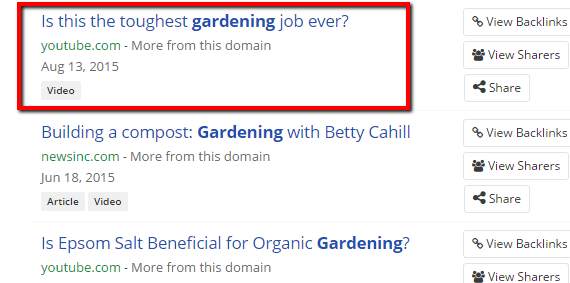
buzzsumo-headlines

For example: Is this the ______ [Your Topic] job ever?

B) Find popular YouTube videos:

youtube-gardening-mistakes
  • Go to Youtube and type in a keyword related to your main topic
  • Look for videos with over 100,000 views
  • Take 2-3 of them and create templates

For example: Top [number] [your topic] mistakes (and how to avoid them)

Step 2: Use Twitter to Test Your Headlines and Find a Winner

Once you have 3-5 headlines, it is time to test which of them is best. To do that, you need to have access to:

  • Twitter account with at least 1,000 followers (or at least get someone with a high follower count to retweet you)
  • Your best time to tweet

First, tweet out one of your headlines when most of your audience is online, wait 24 hours and then tweet out the other headline. Repeat the process with each of your headlines and see which of them got the most engagement. That’s the winner.

This might not be an exact science, but will give you an educated clue of what people want.

As an alternative, you can list out your headlines in 1-3 tweets and ask your followers which they like best. In most cases, this will only work if your audience is copywriters, marketers, or writers.

How to Get More Periscope Followers

The more followers you have, the more reach you’ll get, right? Here are some ways to get the most out of your current resources to get more Periscope followers:

1) Follow Other People

I’ve heard a lot of people who say that the “follow back” approach doesn’t work. That’s BS. It works extremely well. As long as you just follow relevant people and avoid spam you’ll be fine.

The first step is create a list of at least 100 people in your industry who are already using Periscope to market their businesses. Then, follow them and start the conversation.

Start watching their broadcasts, commenting and even creating content around them. If you do that, you’ll definitely get noticed and a good percentage of them (and their followers) will follow you too.

2) Respond to Every Single Comment

People always come back to the places where they feel appreciated.

Think about it: Which store would you come back to? The store where employees are rude, or the store where everyone treats you incredibly well?

The answer is obvious.

If you treat every member of your community like if she or he were the most important person in the world, they’ll feel really appreciated. And one of the best ways to demonstrate your appreciation online is by responding to their comments.

This will encourage more people to follow you because it will help turn followers into evangelists.

3) Don’t Go to the Third Round

Some people will analyze everything you do, including the good and bad things.This is why you need to be careful with what you do. Not only on Periscope, but in all social networks.

What I mean by “don’t go to the third round” is that if someone starts to post negative comments on your videos, don’t fight with them.

You can reply once, but if that person replies back, no matter how much you want to tell them how wrong he or she is, just don’t do it. Ignore that person. If people see that you offend your audience, they won’t follow you.

4) Be Constant

People like to follow people who constantly shares new stuff. If you’re expecting that people follow you because you published a video 3 months ago, you’ll not see the results that you want.

The best you can do is creating a publishing schedule. This way, you and your team can develop ideas and keep your calendar full.

You can schedule a 20-30 minute meeting each week or month to do this.

How to Increase Your Reach

1) Leverage the Power of Brand Evangelists

It doesn’t matter how small your follower base is, you’ll always have a small group of people who always are sharing, commenting and linking to your content.

These are your “brand evangelists”.

Most people make the mistake of trying to connect and engage with every one of their followers. It’s much more effective to focus on creating strong relationships with your evangelists and then let them introduce you to their own audiences.

Focus your energy on the few and you’ll get the most out of the masses. It’s a smarter approach to social media.

2) Find Your Best Time To Go Live

As with anything in social media, there are better times to publish your content than others. For example, Buffer found that on average, tweeting at 5 PM can increase your chances to get noticed.

It doesn’t mean you should share your videos at that time, but it definitely means that you can increase your reach by finding the exact hour where most of your audience is online, so you can share your content at that time.

There are no tools to do this with Periscope yet. However, since Twitter owns this app, a huge percentage of your Periscope followers are already on Twitter (if not all of them), which is very useful.

You can use tools like FollowerWonk or Hootsuite to find your best time to publish content on social media. In addition, this guide from Hubspot will guide you step-by-step through an effective process.

3) Create Co-Branded Content

One of the best ways to grow your audience is by creating relationships with people who have an established audience in your industry, but who aren’t your competitors. This way you can collaborate to create content that both of you can use.

For example, Noah Kagan recently launched a co-branded free training course where he and other industry experts collaborate to help you get your first 1 million visitors. They created special deals, so people who subscribe to the course can get products they own at special prices.

co-branded-content

It’s a win-win.

You can look for relevant people in your industry who are doing it well on Periscope, and then create co-branded live video streaming, so both of you can get introduced to a different audience, and therefore, grow yours.

How to Hack the Advanced Twitter Search to Evangelize Your Videos

One of the best things about Twitter is that you can easily find people who might be interested in your content. Just need to type a keyword in the search bar and Twitter will show you all the people who have shared content on that specific topic.

And when someone shares something on Twitter you know two things:

  1. That person is interested in your topic
  2. That person likes to share content related to that topic

That is very useful because now all you need to do is put your content in front of them.

Here’s how:

Step 1: Go to Twitter and type in a keyword that describes your main topic. For example, if I was going to share a video related to greenhouses, I could look for “gardening”.

twitter-search-gardening

Another option is to look for a specific name. If you know that one of your competitors is doing it well with Periscope, you can search for their name.

Step 2: Click on “more options” and select “Advanced Search”.

twitter-advanced-search-1

Step 3: Fill the form as you need, just make sure to add #Periscope in the section called “these hashtags”. This way, Twitter will show you only tweets that have that specific hasthag.

Remember, we want to find people who might be interested in attending your live video streaming, so is highly important that you follow this step.

twitter-advanced-search-2

Step 4: Make a list of all the people who appear in the results and let them know about your upcoming event. Since they’ve seen and shared similar content before, they’re very likely to attend to your streaming, too.

twitter-search-results-periscope

You can use the following script:

Hi NAME,

I noticed that you tweeted out a Periscope broadcast the other day: TITLE OF THE BROADCAST

Great stuff, I really enjoyed it, too.

I actually have a broadcast on TOPIC coming out on DATE

Let me know if you want a heads up when it comes out :)

Cheers,

NAME

Note: For this strategy to work, I recommend that you create a list of at least 50 people. Also, If you’re wondering how to find a person’s email, you can read this post.

How to Get Tangible Results

One of the biggest problems people have with live video streaming is they don’t know how to achieve results. I’ve found that the reason for it is they simply don’t know how to connect it with business objectives.

We talked about setting your goals earlier in this guide for that simple reason. When your goals are clear, everything is much simpler.

Here are 4 ways to connect the dots between Periscope and your core marketing goals, so you can see tangible results. Choose those ones that better fit your business objectives.

1) Humanize Your Brand

One of your main goals as a brand is to build strong relationships with your audience, and Periscope helps you do that in a very unique way – you can basically open the gate and give to people an inside-look to your company.

Think about it: What better way to humanize your brand than sharing what you do in a common day?

Reality TV is so popular because people love to connect with other human beings. If you share behind-the-scenes content to your audience, they’ll feel more connected with you, and therefore they will trust you more.

2) Product Demos

What better way to offer proof than showing your audience a live product demonstration? This way, they can see in real time how your product actually works and the results they can achieve if they decide to buy it.

3) Customer and Audience Research

Audience research is one of the hardest things when it comes to online marketing (especially when you don’t know where to look). However, once you get it done, you’ll an unfair advantage over your competition.

Periscope gives you the opportunity to learn what your audience really wants, in real-time. You can conduct live Q & A to see what specific questions they ask, you can study comments people are making to find patterns on the way they think, and you can even find untapped keywords they’re using to describe their problems.

This information will help you develop better strategies and help your audience in unique ways.

4) Create Exclusive Content For Your Subscribers

You can create a private group for your blog subscribers and share content that only people who are in your private community can see. This will create an athmosphere of exclusiviness, which people love so much.

Over to You

Periscope is new and fresh. If you think it’s right for your business and goals, then take a dive and start a broadcast using the guidelines we discussed.

Hopefully this guide has shown you that Periscope is a powerful social media tool to grow your brand.

What other tips, techniques and insights do you have about Periscope?

About the Author: Josue Valles is a content marketing evangelist, strategist and die-hard entrepreneur. He constantly blogs about Inbound Marketing, SEO and Social Media Marketing at Engagebit. You can also follow him on Twitter.


from The Kissmetrics Marketing Blog http://ift.tt/1hRhQCT
via IFTTT

What Content Mapping Is & How To Use It To Maximum Benefit

Do you know people who talk and talk and you cannot get a word in edgewise? Of course, you do. When those people talk at you, do you drift away thinking about something else and then float back into the […]

Post from: Search Engine People SEO Blog

What Content Mapping Is & How To Use It To Maximum Benefit

--
Written by Lyena Solomon, Personal Blog

The post What Content Mapping Is & How To Use It To Maximum Benefit appeared first on Search Engine People Blog.


from Search Engine People Blog http://ift.tt/1hR3H8I
via IFTTT

10 Signs You Need Help with PPC

Are you new to the world of pay per click? Or are you getting back in the game after a long hiatus? Perhaps you think of yourself as a PPC expert, but your keywords are accumulating dust bunnies, as you flicked the auto-pilot switch and let Google run the show (pro tip: this doesn’t work).

I hate to say it, but sometimes we marketers have egos a little larger than our skillsets, and we all need a little reality check once in a while.

PPC help gif from Mean Girls of Regina George saying "So you agree? You think you're really pretty?" 

I’ve worked with a lot of intelligent, business-savvy marketers, many of whom are running their own companies, and their success is truly awe-inspiring – yet they’re not always seeing the same success with AdWords. Whether it’s due to a lack of resources, time, or knowledge, it can be hard to identify the signs that you need help.

To run a successful business, you have to admit to yourself that you can’t do it all. Many companies have an entire team running their paid search, so it’s nothing to be ashamed of. So what are the warning signs? Let’s dive into the top 10 signs that you need help with your PPC, and how to get help!

#1: Your Account Is Disorganized

This is the number one red flag that the PPC struggle is real. Tackling a mess of an account structure can be quite the task. The funny thing is, it’s shockingly easy for PPC marketers to find themselves in a web of AdWords clutter – I see it all the time in new client accounts. So, what are the easiest ways to identify that your account structure is in need of major renovations?

  • Overstuffed Ad Groups: Do you have lots of ad groups with over 25 keywords? Be careful: Having too many keywords per ad group leads to relevancy issues, and if you dig into the data you’ll most likely notice that only a handful of your keywords are generating traffic. You want to ensure your keywords match your ad copy, and if your ad groups have tons of keywords, the chances that all of those will match your ad text is slim.
  • Irrelevant Groupings: This typically ties in with overstuffed ad groups, but it can go even beyond that. The structure of your account is like the foundation of a house – if it’s not set up correctly, it could have disastrous consequences. Your campaigns should have a relevant theme that ties into the ad groups, which should be grouped based on keyword semantics. Keywords should relate directly to the ad copy and landing pages that searchers are being directed to.

 PPC help example of search term matching a keyword

  • A Huge Number of Campaigns and/or Ad Groups: Unless you’re a massive retailer selling

globally, your account likely does not need to have thousands of ad groups or campaigns. Accounts with too many ad groups or campaigns end up stretching their budgets far too thin, or have a bunch of junk ad groups that aren’t generating any revenue and few impressions. Your account needs to be decluttered to focus on the campaigns and ad groups that actually provide ROI.

#2: You Inherited an AdWords Account OR Have to Build One from Scratch

These two scenarios both leave the PPC employee in the same pickle: “Where do I go from here?

If you’re inheriting an account it can be extremely challenging to understand how to make appropriate optimization decisions moving forward. You need to dig into the past history, investigate metrics like average CTR, CPA, Quality Score, impression share, and average positions to set realistic goals and understand where you are in terms of industry standards. Is conversion tracking set up? How is attribution being handled? Is there a mobile strategy in place? Unless you have support from the previous account manager, taking over an account that was already running can be extremely challenging to do alone.

Building out from scratch can leave you in a similar situation, wondering where to start. As I explained above, the way an account is structured can make or break the performance of your PPC campaigns. Creating an entirely new AdWords or Bing account requires a tremendous amount of attention to detail, not to mention a strategy for structuring, and unfortunately there’s no one right way to structure an account since each industry and company is unique.

Ppc help account structure 

Both of these scenarios scream HELP!

#3: Your Click-Through Rates Are Low

Did you know that the average click-through-rate (CTR) for the Search Network is 2% (according to Google)? CTR is the ratio of clicks to impressions on your ad, so a CTR of 2% means that out of 100 impressions, you got two clicks through to your site.

So if your CTR is 2%, you’re good? Well, not necessarily. The average CTR is different for every industry and business model. Plus, if 2% is average, don’t you want to be above average? CTR also varies depending on the position of your ad. As you can see in the graph below, the higher your ad rank, the higher your CTR tends to be.

 Ppc help graph of showing correlation between high positions and high CTR's

Wait, why do we want high CTR’s in the first place? The higher the CTR the more you have to pay, right? Not necessarily… According to WordStream founder Larry Kim, advertisers with low CTR’s end up paying up to 400% more for fewer clicks because of the penalty for lower Quality Scores. Not only does having lower click-through rates negatively impact your Quality Score (which impacts the amount you pay per click), it also affects your impression share (how frequently Google displays your ads).

There are lots of ways to improve the CTR of your ads, from testing your ad creative to adding extensions, but if they’re low across the board, you definitely need help!

#4: You’re Responsible for Social Media, SEO, Content Marketing, etc. etc. etc.

Ah! The multiple-hat wearers! Hats off (ahem) to those employees that are able to do it all.

The problem is, many of us are not able to do it all effectively. If you’re juggling a thousand responsibilities it’s incredibly easy to shove your AdWords account in the corner. We’ve found that half of small-business marketers – the ones most likely to be extremely busy and trying to do it all – only do ad optimizations once per quarter. You let the dust accumulate until you realize you’ve wasted thousands of marketing dollars on irrelevant searches.

The thing with PPC is, you cannot set it and forget it. Many multitasking marketers end up learning this the hard way. Luckily, there are ways to save your account from neglect. If you’re able to, block off some time in your calendar each week to focus on AdWords, and create a workflow to follow and track your progress. Even 20 minutes per week can make a big difference!

#5: Your Average Keyword Quality Score Is 5 or Lower

Quality Score, the mysterious metric that everyone loves to hate. What is it exactly? It’s essentially the score of how much Google likes you on a scale of 1 to 10. You want Google to like you a lot because you’ll end up paying less for the highest positions with the most visibility.

Some known ways to improve Quality Score include improving relevancy between your keywords, ads, and landing pages, as well as achieving high CTR relative to the expected CTR at your ad position. While QS is extremely important, it’s also difficult to control and improve. If the majority of your keywords in your account have Quality Scores below 5, then Google isn’t finding your account too attractive, and you’re likely paying a lot more per click to rank below your competition. This is one scenario that 100% requires help.

PPC help graph showing correlation between QS and CTR 

#6: Your Spend Is Off the Charts (But Your Conversions Are Not)…

If you’re not seeing revenue flowing in, it’s a MAJOR issue that needs to be addressed. What’s the point of advertising at all if you’re not making a return on what you’re spending?

Could it be that AdWords simply doesn’t work for your business? I’m not buying it… Most people who think AdWords doesn’t work are making one or more mistakes:

So many factors can come into play, so you need help to figure out why you’re not seeing ROI with your PPC efforts.

PPC help  

#7: You Aren’t Sure How & When to Adjust Bids

Understanding how to set budgets and bid properly is probably one of the most challenging aspects of PPC, because it’s an auction that is constantly changing. What you’re bidding for your top converting keywords one week might not work the next week, depending on the ebb and flow of the auction. Also, how should you prioritize your budget? How much should you even be spending all together? And then how do you divide that between campaigns or between search and display?

These are common questions PPC practitioners have – it can be unpredictable whether or not you’re going to get return from your spend, so naturally marketers are nervous. I had one client that set his daily budget for a campaign at $10/day because of his nerves. One day he called me, upset, saying, “My entire budget was spent on 1 click!” I took a look at the account and saw that the keyword search that was triggered cost $10, so yes, it made sense that his budget was depleted.

Determining realistic budgets, setting and optimizing keyword bids can be a complicated process. While auto-bidding might seem like the easy way out, DON’T DO IT. Giving Google the reins isn’t always the best idea, especially when it comes to your ad spend. If you don’t believe me, check out Caleb Hutchings’ post on the five reasons automatic bidding is never a good idea.

#8: You’re Afraid to Try New Things

The most effective PPC marketers are analytical, creative, hands-on individuals who are NOT afraid to try new things. In fact, being an early adopter can have serious advantages – if you’re among the first to jump on a new AdWords feature, you can reap all the benefits of higher CTR before your competitors catch on and even the playing field.

But too often, advertisers don’t even know about new features, or worry that experimenting could tank their accounts. So, how do PPCers keep up? Well, staying informed is one way – whether it be through the official Google AdWords blog, on Twitter’s #ppcchat, or following publications like Search Engine Watch. Don’t be afraid to make changes and try new things, like the super-effective call-only campaigns,  because in the long run you will benefit from staying ahead of the game.

 PPC help 

If you are afraid to try new things or don’t have time to keep up-to-date with Google’s ever-changing landscape, then yes, you need help!

#9: You Rely on Google’s Suggestions to Optimize

Don’t get me wrong, I’m a huge Google AdWords fan. I’ve spent tons of time in the interface, and the advertising platform they’ve build is insanely impressive. And it’s getting better with new tools and features all the time.

Yet, if you’re solely relying on the optimization tips that AdWords provides, then Houston, we’ve got a problem! No, they’re not all bad, but you will likely notice that Google’s solution is often to up your budget or bids. While this is needed at times, there are usually other things you can do to improve results, rather than simply adding more fuel to the fire. (Wait until you’re profitable to do that.)

ppc help google alerts saying to increase budgets 

Moral of the story, if you’re solely dependent on Google’s suggestions when optimizing, then you need help.

#10: You Don’t See the Value in Paid Search

Just read this post. That’s all.

What Now? Tips to Get the PPC Help You Need

Ok, so we’ve figured out that you need help. What’s next?

There are many options, but the trick is figuring out what’s right for you in terms of time management, resources, and your marketing budget. Here are three options to decide from.

  1. Help yourself! This is the most challenging option. You haven’t been able to do that thus far so why should you be able to now? If you’re able to carve out the time to really LEARN the ins and outs of paid search and continuously block time on your calendar to optimize each and every week then this could be a plausible option.
  2. Hire an Agency or New Employee to Take Over: This is likely the most costly, and somewhat risky option. Often clients come to us from an agency experience gone wrong. Yet, there are many great agencies out there that will take the time to actually learn your business, and run your account effectively. The struggle comes in finding the right one. The same goes for hiring a new employee to do the job.
  3. Do-it-Yourself with Software: This is the best option for those of you who don’t have the time to help yourself, but also don’t have the money (or faith) in handing over your account to an agency or new employee. Software can make your job much easier by automating some of the more time-consuming parts of PPC management and showing you where to start.

PPC help screenshot of the grader

Still not sure if you need help or not?! Use our (newly redesigned!) AdWords Grader to get a free audit of your PPC account. Your personalized report will show you exactly how your PPC account is performing compared to other advertisers in your industry and with similar budgets, including tips to improve your weakest areas.

About the Author:

Margot is a Content Marketing Specialist at WordStream with a background in PPC, SEM, content and digital marketing. Margot is passionate about writing and is also a regular contributor to Search Engine Journal and socialmediatoday.com. Margot was recently named the 25th Most Influential PPC Expert in 2015 by PPC Hero. She enjoys running, sleeping on the beach, and eating ice cream during her free time. Follow her on:

Twitter: @ChappyMargot

Google+: +Margot da Cunha

LinkedIn: http://ift.tt/1B7RySO


grade your adwords account


from Internet Marketing Blog by WordStream http://ift.tt/1UoZrsU
via IFTTT

Consumer Survey Reveals the Efficacy of Inbound vs. Outbound

Posted by KelseyLibert

We've all heard the decades-old myth that the average consumer is bombarded with up to 5,000 ads a day. But if someone wanted to, he or she could get that number closer to zero. Just search for "how to block ads" and you'll find more than 700 million answers.

Ad-avoidance is a growing issue for marketers and advertisers; recent data from Adobe made a stir due to their finding that 198 million people are blocking ads. Since ad blocking is mostly a desktop browsing phenomenon, there's a lot of room for it to become commonplace across all devices. For example, Apple's upcoming iOS9 will include support for ad-blocking extensions in Safari, so we may see a lot of people adopting ad blockers as part of their mobile browsing experience too.

Additionally, a recent survey by Fractl and Moz found that 58% of respondents were using some form of ad-blocking software.

3.png

With the growing resistance to interruptive marketing, it's clear that consumers are fed up with low-value, high noise marketing. But are some of these tactics and channels still an effective ingredient within a holistic marketing approach? Better yet, is inbound marketing any better in the eyes of the consumer?

Fractl and Moz have once again teamed up for exclusive research, examining various marketing tactics' efficacy and efficiency.

header.png

The first part of our research focuses on marketing efficacy. For this, we'll share consumer survey results regarding different traditional and digital marketing and advertising channels' ability to gain awareness, drive action, and influence purchasing decisions. For the second part, we'll look at the efficiency of these same media by breaking down what a $10,000 spend can achieve across several different channels.

I. Efficacy: What Gets Results?

Survey Methodology

For this study, we went straight to the source: the consumer. In July 2015, we conducted an online survey of more than 1,000 people. Participants were asked 13 questions regarding their opinions on and recent engagement with various marketing and advertising media as well as tactics, including traditional advertising (TV, radio, print, billboards), direct mail, social media, content marketing, online search, display ads, ad retargeting, email marketing, paid search ads, mobile app ads, and sponsored story links.

A few considerations:

  • Within the survey questions, "traditional advertising" was defined as TV, radio, billboards, and print ads.
  • We provided participants with visual examples of terms they may not have been familiar with, such as pay-per-click ads in the SERPs, retargeting, and sponsored story links.
  • Participants skewed young; the majority were between 18 and 34 (73.2%).
  • A majority of respondents were male (58.4%).

Survey Overview

Before we dive into the full survey results, here’s a glimpse into our findings:

  • Most likely to have a positive influence on buying decisions: Customer reviews, search, online articles, traditional advertising, and direct mail
  • Most likely to have a negative influence on buying decisions: Mobile app ads, display ads, paid search, and email marketing
  • Most effective for attracting business: Direct mail, content marketing, and appearing in search results
  • Popular methods for self-education: Search, visiting a company’s website, and customer reviews
  • Most-noticed digital ads: Display ads, media ads, and mobile app ads
  • Best outbound channels for grabbing attention: Traditional advertising, email marketing, and social ads

The resulting findings are not an all-encompassing, all-knowing guide to which types of marketing people want. Rather, these insights may give you a new perspective on approaches you may not have considered before or may have believed to have dubious efficacy. For example, you may be just as surprised as we were to see how effective consumers find direct mail. Furthermore, these findings may simply reinforce the efficacy of your current marketing mix or what you already know about consumer behavior, especially the section about online discovery preferences.

1. Awareness of online advertising is high, but more than half of respondents are not engaging with these ads and/or actively preventing them from showing up.

last-30-days.png

The majority of survey respondents are aware of and notice the various online ad formats. Around three-quarters noticed display ads within 30 days of being surveyed. The majority had noticed all of the ad formats we asked about.

Q11.png

More than half (53.8%) reported they had not clicked on any ads within a week of being surveyed.

  • Nearly a quarter (24.4%) clicked on a social media ad in the last week, the highest of any online ad.
  • Somewhat surprisingly, sponsored story links were the second-most clicked, at almost 18%.
  • More than 16% clicked on a display ad, which seems high considering a majority of respondents are using ad blockers (57.5%).
  • Under 10% of respondents clicked on PPC ads.

2. Out of outbound and paid channels, traditional advertising, email marketing, and social media ads are most effective at grabbing attention.

grabbed-attention.png

More than half of our respondents rate traditional advertising high for grabbing their attention. There is arguably no better way to reach a mass audience than through traditional advertising. Plus, studies show it remains effective for not only awareness but driving other KPIs. A study by Nielsen found that radio commercials are effective at driving brick-and-mortar traffic, with advertisers gaining an average $6 return for every $1 spent. And a recent MarketShare study rated TV as the most effective ad medium, citing "TV is a major driver of indirect outcomes such as inbound calls, organic search query volumes, and website visits."

With a direct line to consumers' virtual centers of attention – their inboxes – promotional emails were next best for grabbing users' attention, at 41.3%. Social media ads were the third-most attention-grabbing, catching the eye of 35.8% of respondents.

Which ad formats aren't particularly attention-grabbing?

  • PPC ads were found attention-grabbing by just under 10% of respondents.
  • 16.5% found that mobile app ads grabbed their attention.
  • Sponsored story ads were attention-grabbing for about 18%.

3. More than 88% use online search to seek out more information about a company, and greater than 93% had done so within a week's time.

learn-more-about-company.png

Online queries are a ubiquitous part of daily life, so it's not surprising that 88.3% of respondents use online search to research a product or company. Just over 85% visit a company's website and 81.9% read customer reviews to learn more.

Other self-education methods are significantly less popular than using search, visiting a company's website, and reading reviews. More than a quarter (27.4%) follow a company's social media accounts to learn more about it, and 10.7% learn about a company by downloading content from its website.

Asking respondents about their online behavior within the last week gave insight into how often they're seeking out information online – allowing companies to market to them – and consuming online content.

4.png

A whopping 93.2% – almost the entire survey sample – used online search to find information about a company or product within the last week. Also within a week's time:

  • 89% read an online article.
  • More than half (50.8%) downloaded content from a website and gave a company their email address (50.2%).
  • Over a quarter (28.5%) followed a company on social media.

Notice almost just as many people downloaded content from a website as gave a company their email address, which may signal a relationship between handing over their email address in exchange for the content they downloaded.

4. Customer reviews, online search, and online articles have a positive effect on buying decisions for a majority of respondents.

Q13.png

About 85% are positively influenced by customer reviews. 45% are significantly more likely and 40% are slightly more likely to buy something they hear about via customer reviews.

More than three-quarters (77%) are positively influenced by online search. 25.7% are significantly more likely and 51.3% are slightly more likely to buy something they hear about via online search.

More than half (56.7%) are positively influenced by online articles. 9.3% are significantly more likely and 47.4% are slightly more likely to buy something they hear about via online articles.

Interestingly, email marketing was most likely to negatively impact buying decisions, with about 44% of respondents slightly less likely (22.9%) or significantly less likely (21.4%) to buy something they hear about via email marketing.

Feelings tend to be neutral toward a company's social media posts and press releases, which don't affect purchasing decisions for 42.8% and 48.6% of respondents respectively.

5. Compared to other outbound and paid tactics, traditional advertising has the most positive effect on buying decisions, followed by direct mail.

Q12.png

Traditional advertising has a positive effect on purchasing decisions for about two-fifths (42%) of respondents. 6.2% are significantly more likely and 35.8% are slightly more likely to buy something they hear about via traditional advertising.

Direct mail positively impacts buying decisions for just over 30 percent. 4.2% are significantly more likely and 27.7% are slightly more likely to buy something advertised via direct mail.

Still, it's worth noting traditional advertising and direct mail are significantly less impactful than hearing about a company or product through other sources such as customer reviews, online search, or online articles:

  • Customer reviews are two times more likely to positively influence buying decisions than traditional advertising.
  • Online articles' positive effect on buying decisions is 56% greater than direct mail.
  • Hearing about a company through online search is 1.8 times more likely than traditional advertising to have a positive impact on purchasing decisions.

On the other end of the spectrum, some ads have a negative effect on a person's likelihood to buy something. Mobile app ads, display ads, and paid search ads are more likely to have a negative effect on buying decisions, compared to other methods:

  • More than half (54.3%) say mobile app ads have a negative influence. 31.4% are significantly less likely and 22.9% are slightly less likely to buy something advertised via mobile app ads.
  • Nearly half (48.1%) are less likely to buy something advertised in display ads. 25.7% are significantly less likely and 22.4% are slightly less likely to buy something advertised via display ads.
  • Paid search has a negative effect on just under half (49.4%). 25.3% are significantly less likely and 24.1% are slightly less likely to buy something advertised via pay-per-click ads in search engine results.

6. Direct mail, online content, and search are the most effective ways to attract customers.

Bars_Business.png

Direct mail and content marketing come out on top, with more than half of respondents rating these as smart ways to attract their business. Nearly half (48.3%) say showing up in search results when they have a want or need can help attract their business.

Additionally:

  • Well over a third of respondents consider traditional advertising (37.6%) and email marketing (34.6%) effective ways to win them over.
  • About a quarter of respondents rate social media posts (27.4%) and social ads (24.8%) as smart tactics for attracting their business.
  • Only 6.6% of respondents consider mobile app ads an effective tactic for earning their business.

While our survey results tip in favor of inbound (search, content) and third-party endorsements (customer reviews), our respondents do find several outbound tactics effective, especially traditional advertising, for grabbing their attention and direct mail for attracting their business. But efficacy is only part of the marketing equation ...

II. Efficiency: What's the Best Value?

In addition to efficacy, the cost of getting results, or efficiency, should be given significant consideration for what to include in your marketing mix. Marketers are continuously tasked with doing more with less, so finding the most cost-effective methods for getting the greatest results is the holy grail for marketers.

Cost Comparison of Various Marketing Channels

Cost is typically touted as a large benefit of inbound marketing while being a barrier for choosing more costly outlets like TV and print media. To get a better sense of the efficiency of different channels, let's look at the potential costs of a campaign designed to generate awareness.

CPM (cost per mille) is commonly used across a variety of ad mediums to measure the cost of a thousand impressions.

CPM = (Cost of Ad x 1,000)/Audience Size

In the ad-buying world, this is used to measure the efficiency of an ad medium. Focusing on this CPM makes sense for campaigns that want to achieve high awareness by getting a message in front of a substantial audience.

Since so many variables impact the actual CPM rate you would pay for a given medium, the chart below should be used for informational purposes only. However, these figures do give an idea of the huge difference in the price you will pay to reach a certain audience size across various advertising and marketing channels.

Bars_CPMs.png

Direct Mail Pricing

You'll notice direct mail is missing from the chart above. With a CPM of $583 for a letter-sized envelope direct mail piece, it didn't exactly fit nicely in our chart.

Bars_mail.png

Paid Search Pricing

Although CPM is used in paid search, cost-per-click (CPC) is the more commonly used measurement, so we'll use that as our benchmark rather than CPM.

Paid search costs can vary greatly depending on vertical, keywords, and targeting. While some keywords may only cost a handful of change per click, extremely competitive keywords can cost more than $5 per click. The chart below shows average CPC pricing data across nearly 700,000 keywords for a variety of verticals during 2014.

Bars_Google_adwords.png

Based on the figures above, the lowest CPC is $0.38 and the highest CPC is $4.41. This puts our median CPC at $2.40. The average CPC for this data set is $1.70.

A note on CPC vs. CPM: Both are typically offered as options for paid search, display, and social ads. The chosen pricing model depends on campaign goals and budgets. CPM is often chosen for awareness-based goals and CPC is better for performance-based goals like traffic or conversions.

What a $10,000 Budget Can Buy

Based on the above pricing, let's look at how far a $10,000 budget would get you.

Extremely High CPM: Direct Mail

With a CPM of $583, for $10,000 you could send a letter-sized direct mail piece to 17,152 households. According to the Direct Marketing Association, the median ROI for direct mail campaigns using a prospect list is 12–14%, so this type of return on investment may be worth the high upfront costs.

High CPM: Local Market Primetime TV

A primetime spot TV commercial has the highest median CPM, at $33.85. (Spot TV means your commercial only plays for a local market, not a national market.) With a $10,000 budget, you can reach almost 300,000 local market viewers at that CPM rate. That's actually not such a bad deal – but keep in mind, it's for a one-time, 30-second spot and this is just the price to air the ad. Other cost considerations include producing the commercial, which may include script writing, editing, voiceover or acting talent, etc.

Mid-CPM: Magazines

Magazines fall somewhere in the middle of the pack, with a median CPM of $14.00. With a $10,000 budget, you could afford an ad in a magazine with a circulation of about 715,000 readers. Pricing varies based on the size of the ad, color or black and white, page position, and position within the magazine. Also consider the cost of the ad creative, such as copywriting and design.

Low CPM: Facebook Ads

With a CPM of $1.54, Facebook advertising is the most budget-friendly of the bunch. At that rate, $10,000 can pay for almost 6.5 million impressions. This budget would allow you to reach a ton of Facebook users at once or target the same people with multiple ads over a long period of time. Keep in mind, Facebook ad CPMs and CPCs typically become more expensive the more granular your targeting becomes.

CPC: Paid Search

A $10,000 campaign with a CPC of $2.40 would guarantee at least 4,167 clicks. The same amount spent for a $1.70 CPC would yield 5,882 clicks. For some perspective on how many people would see the ad, assuming a 5% click-through rate, the ad with a $2.40 CPC would get about 83,330 impressions and the $1.70 CPC ad would get about 117,640 impressions.

The CPM of Content Marketing

Content marketing is a little trickier to cost out since there's no industry-wide standard unit of measurement for things like impressions and costs-per-click, which makes an apples-to-apples comparison between the cost of outbound, paid, and inbound difficult. However, we do have a recent, relevant example of the price of content marketing versus TV.

Content marketing can garner viewership similar to a sizable TV audience – but for a fraction of the price. We recently had a Fractl client campaign placed on BuzzFeed that achieved more than 3.2 million views within several days of publication.

11.pngAccording to the rates above, you would have to pay around $75,000 for a 30-second TV spot on a primetime network TV to reach a similarly-sized audience.

Add the additional viewership from syndications and social sharing, and the equivalent in terms of viewership is probably similar to what more than $200,000 would buy you for a TV commercial. Not to mention the SEO value derived from the content.

With a Fractl campaign of this scope averaging $10,000 for end-to-end strategy, production, and promotion, that makes the CPM roughly $3.13.

what-10K-marketing-spend-can-buy.png

While a $10,000 Facebook ad spend can garner the most impressions, the same budget going toward a large-scale content marketing campaign can include benefits beyond exposure to a huge audience, such as increased rankings, syndication, and long-term visibility.

Key Takeaways

Choosing the right marketing mix depends not only on how well a given channel and tactic are for the KPIs you want to achieve, but also your available budget. Striking a balance between efficacy and efficiency is crucial for a long-term, sustainable marketing strategy.

In summary, below are some of the main takeaways from our findings:

Awareness:

  • Traditional advertising Loudmouths digital advertising when it comes to grabbing attention. Email marketing and social media ads came in second and third, respectively, for grabbing viewers' attention.
  • The majority of respondents used search engines and or read online content within a week of being surveyed, making these effective avenues for getting in front of your target audience.
  • To learn more about a company, a majority of survey participants turn to search, the company's website, or customer reviews.
  • Display ads were the most-noticed digital ads, but had low engagement.

Conversions:

  • More than half had downloaded content or given a company their email address within a week of being surveyed, which may be due to opting-in for content offers in exchange for their email.
  • Customer reviews, search, and online articles have the most positive effect on buying decisions.
  • Of the outbound channels, traditional advertising and direct mail were most likely to have a positive effect on buying decisions.
  • Respondents rated direct mail as the most effective way to attract their business.
  • Survey participants also said offering them free content or appearing in search results are some of the best ways to win their business.

Cost:

  • Based on our cost analysis, content marketing and Facebook advertising are the most cost-friendly ways to reach a wide audience.

Want to see more data from our consumer survey? We've also filtered out the Millennial segment within the survey responses (18- to 34-year-olds) to extract additional insights. For our findings on how Millennials feel about various marketing tactics, be sure to download our free white paper.

Millennial Marketing


Sign up for The Moz Top 10, a semimonthly mailer updating you on the top ten hottest pieces of SEO news, tips, and rad links uncovered by the Moz team. Think of it as your exclusive digest of stuff you don't have time to hunt down but want to read!


from Moz Blog http://ift.tt/1JIPH6R
via IFTTT