- Getting Social with Benchmark Email Marketers
- Affiliate Marketing: How to Set Up an Email Course
- Permission Based Email Marketing: The Magic of the Welcome Email
from Benchmarkemail Blog http://ift.tt/1Y29gQg
via IFTTT
The following is a guest post written by Ryan Robinson, an entrepreneur and writer who teaches people how to start meaningful, self-employed careers at ryrob.com. If you’re looking to start a business while working your day job, check out his upcoming online course, The Launch While Working Formula.
Since it’s inception, email marketing has catapulted into becoming the primary method by which most businesses generate a substantial portion of their revenue.
In fact, a few of my products are only available for purchase if you’re in my email community. To me, email marketing represents so much more than just a revenue driver for my business.
There’s already an incredible amount of resources out there about how to use email marketing for growing your email list and bringing in revenue. But not much is said about how you can use your email marketing to actually build more meaningful relationships with your subscribers. Relationships that are beyond just transactional.
In a world of increasing personalization and growing consumer demand for experiences that are custom-tailored to their exact wants and needs, both brands and individual business owners have a lot to learn about how to use their email marketing to create a reputation that’s built on something deeper than dollar signs.
Each week, I get anywhere from twenty to a hundred replies to my weekly updates and personalized autoresponders. While no doubt time consuming, choosing to create email content that directly calls my audience to action, engages me with many of my subscribers on a one-on-one basis.
I use a very simple principle employed by all great conversationalists, to get my subscribers to share with me – ask people to talk about themselves. This alone has had a dramatically positive impact on both the engagement and revenue on my website, ryrob.com.
Here’s an example of my primary autoresponder that new subscribers receive when they download one of my pieces of content, sign up for a waiting list, or for my weekly email updates on starting a profitable side business.
The subject line is simply, “Hello from Ryan.”
It’s short, to the point, shows my personality, and calls all of my new subscribers to one specific action. I ask each and every new person who joins my community to reply with their #1 question they want answered about starting a business while keeping their day jobs, which is often the reason they discovered me in the first place.
I get anywhere from 40-100 new subscribers on an average day. Since my autoresponders are so focused and personalized, about 10% of these new subscribers reply to them, which sets in motion a lot of one-on-one relationships with members of my community.
The open rate on my autoresponders hold steady at above 70%, which is almost unheard of in email marketing, especially for an email that really isn’t essential to open in the first place.
Through these exchanges, people share very personal stories, struggles, failures, ask highly detailed questions, and give updates on their progress as time goes on. I reply to every single one of them. It often takes me a week or two (or longer), but I make it a point to reciprocate the vulnerability they show, in taking the time to write me personally.
Beyond just my autoresponders, I extend my deep personalization and vulnerability into my weekly email broadcasts.
Each week, I share with my community something I wrote either on my blog, for a publication, or brand that I’m working with. All of my broadcasts start out with a personal story, transition into a critical lesson I learned in business (usually the hard way), and end with asking my community to read the related post & take a specific action either in the comments or by replying to my broadcast.
Here’s an example of a reply I received from a recent broadcast, where I shared the story and lessons learned, from my biggest failure as an entrepreneur.
This has become a winning formula for me.
Because my community knows I care about them personally, the open rates of my weekly broadcasts stay well above 30% with click rates around 10%.
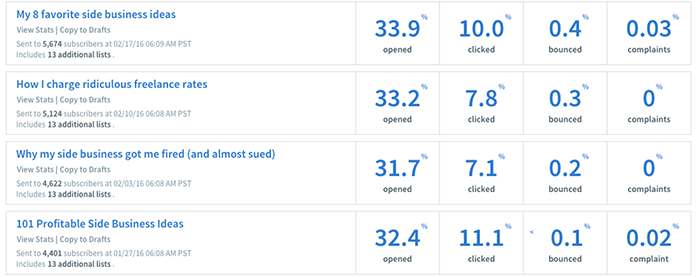
The vulnerability I show through storytelling in my email marketing helps me establish deeper connections than if I were to simply deliver a bland RSS-template email each week with a new blog post.
This approach isn’t for those who are looking to turn a quick profit on their email list. It’s an investment you’re making in your business, that over time pays off in great dividends.
Vulnerability and personalization always start the conversation. However, you’ll need to deliver on the value you’re promising, time and time again.
Over time, this is what allows me to warm up my audience, build long term relationships, and establish a platform of trust based on the genuine value and personal insights I provide through content like my detailed breakdown of the best tools for starting an online business.
After the foundation of trust is established, occasionally, I offer something deeper than everything else I cover for free on my site.
This is usually in the form of a course or activity that’s transformational enough to charge for, and if it’s relevant to a segment of my audience, I’ve already provided enough value to them, that their decision to buy isn’t impeded by a lack of confidence in me. They’re already sold on me as a person, which makes the decision to buy something I’ve created for them, much easier.
The first online course I created on Writing a Winning Freelance Proposal last year, was launched directly to a small segment of my email list that signed up for the waiting list to purchase this course once it became available, just over 400 people in total.
In the first week the course launched, 28 of my subscribers purchased the course, a 7% conversion to purchase rate at a relatively high price point of $129.
It’s no coincidence that most of the members of my community who end up purchasing a paid product of mine are those whom I’ve had one-on-one email exchanges with prior to purchase.
Email marketing helps grow my business in several ways.
Instead of viewing your email list as a means to make money for your business, think about it as a vehicle to provide value to your subscribers. The amount of value you provide to your subscribers is particularly important when you’re just getting started with building your brand, because you don’t automatically command their trust. You have to work for it.
Ask yourself how you can provide such an insane amount of free value to your subscribers on a regular basis, that once you do offer a paid product, they are jumping at the opportunity to pay for more.
Take for example, my 9,000 word post about the best business ideas. It’s one of the largest organic traffic drivers to my website, and because it’s incredibly detailed, it converts into the most new subscribers for me each day.
Start with these simple, yet often overlooked questions to deliver more value to your subscribers, the way they want to receive it:
From a revenue perspective, my email list serves as the primary, and often the sole channel, through which I offer paid products and consultation sessions.
My subscribers are the people who know me best. The people who I’ve built trust-based relationships with. Ultimately, they’re the people most likely to value and pay for my services.
All things being equal, people will always prefer personalized products and services. You need to write like you’re speaking to the individual person at the receiving end of your email.
With that in mind, I recommend adopting a very conversational tone with your email marketing. Having a style of conversation that shows your personality and differentiates you from the corporate sounding marketing emails will help you build the foundation for stronger long-term relationships.
Use first name personalization whenever possible. How much more likely are you to open an email that starts with addressing you by first name, compared to a more generic-sounding email that’s more clearly designed to sell you something?
Regularly ask what pain points your audience has, and you’ll get valuable feedback about future offerings you can create. Take time to read their responses and reply as much as possible. This will significantly help deepen your personal connection and nurture relationships that’ll strengthen over time.
Become a storyteller with your email marketing.
Share things that make you uncomfortable. Bring your subscribers closer to you, by getting them personally invested in your journey. If you can get them to care about you and your mission, you’ve already won half of the battle.
Ask yourself these questions to determine how you can effectively convey your vulnerability with your email marketing:
Having a full-time business, or even one you’re just running on the side, takes an enormous toll on your time and energy.
Autoresponders, customizable email messages that follow a preset deliverability sequence, help you build one-on-one relationships with your subscribers.
In my experience, autoresponders provide my audience with more meaningful and individualized experiences. This in turn, helps build stronger connections, deeper engagement, and higher conversion rates.
Make sure your autoresponders meet the following criteria:
Think about the truly great marketing emails you receive. You don’t want to unsubscribe, and in fact you probably want more.
Your goal is to keep your subscribers always wanting more, and give them a clear expectation as to when they’ll be receiving more. Choose a regular cadence that you can realistically commit to for sending great email updates to your community.
I personally send weekly emails, so that I’m regularly appearing in my subscriber’s inbox. I want to stay very top of mind, so that they don’t forget who I am and the value I regularly provide in their lives.
But, it’s easy to bite off more than you can chew in this department.
Start with evaluating how often you can produce new content that your audience will be interested in. You absolutely need a call-to-action in your emails, because it trains your audience that they’re supposed to take action every time they open your emails. So, if you can only commit to publishing a new blog post, video, quiz, or something else, once a month, it makes sense to have an email frequency of once a month.
The only thing worse than not staying in frequent contact with your subscribers, is wasting their time with too many emails that don’t provide genuine value.
The relationships I carefully build through my email marketing, are always meant to reach far into the future.
I gladly sacrifice the dollar today for the opportunity to show how helpful I can be with free content, and eventually offer a much more premium solution that digs deeper into helping my audience achieve their bigger goals. That’s exactly what I’m doing with my upcoming course, The Launch While Working Formula.
If you hope to eventually generate revenue from your email list, you have to provide value first. It’s as simple as that. If you aren’t willing to provide that free value, your subscribers will seek it out elsewhere.
The post How to Use Email Marketing to Build Meaningful Relationships appeared first on Email Marketing Tips.
Recently, the media has been abuzz with stories on the rise of ad blockers and the implications for digital markets. Internet users have not hesitated to weigh in with their two cents on online ads, and the general consensus is that they find them to be dull, preachy, and downright intrusive.
Many advertisers ignore this feedback, adopting the mindset that ads are ads—no one LOVES them.
I challenge you to think differently.
The reality is, people love ads when they’re great. Every year, I eagerly await the Super Bowl—not because I am a football fanatic (in fact, I barely understand the rules of the game!), but because I can’t wait to see the ads shown during commercial breaks. Super Bowl ads are in a class of their own — they range from shocking to endearing, from thought-provoking and inspirational to slapstick humor— they take viewers on an emotional rollercoaster throughout the night. The best of the best (think: Larry Bird challenging Michael Jordan for a BigMac, E*Trade’s dancing monkey or Liam Neeson taking on Clash of the Clans) are remembered for years to come.
This ad was aired when I was five years old and I STILL remember it!
Account managers should strive to make every PPC ad Super Bowl caliber. Think it can’t be done in only 95 characters? Think again! Here are five fool-proof ways to create super-creative PPC ads that your target audience will actually like.
I’m sorry to report that your searchers’ attention spans are on the decline, as a result of the “digital age.” In fact, according to a recent Microsoft study, a goldfish can concentrate longer than the average human! This doesn’t bode well for PPC advertisers, who are competing with numerous ads and organic listings to snag a searcher’s attention.
Writing a catchy, enticing headline is the best way to capture your audience’s interest. The problem is, it’s not always easy to dream up this clever prose. Rather than reinventing the wheel, check in with your team to see what headlines are working best for other channels. Chances are, they’ve identified titles working well for webinars, whitepapers, emails and even blogposts that you can adapt for your PPC ads.
If you aren’t able to find any gems internally, turn to Buzzsumo. This platform allows you to see which pages of a particular website have had high social engagement rates—and likely awesome headlines. See what’s working well for others in your space and then put a spin on them for your PPC ads!

Earlier this year, our team here at WordStream posted an ad on multiple channels to promote a guide called 69 Creative Marketing Ideas to Boost Your Business. This ad KILLED it—it raked in a 60% higher than average click-through rate on Facebook alone. We were thrilled by its positive performance, but also thoroughly perplexed. It was a good guide, but it certainly wasn’t the most ground-breaking information we’ve ever published.
And then it dawned on us. One thing was capturing our readers’ attention. SIXTY-NINE. This completely unintentional, vaguely sexual reference was attracting loads of clicks!
Now, the notion of using sex in advertising is certainly nothing new. We’ve seen it for decades. In fact, it dates all the way back to the late 1800’s when Pearl Tobacco featured a naked maiden on the cover of their packages. This strategy was so successful that various tobacco companies emulated it and even began including trading cards featuring beautiful, nude women in each pack of cigarettes. It wasn’t long before other industries hopped on the bandwagon.
That said, sexual references seem to be underutilized in the paid search space. We gave it a shot earlier this year with a weight-loss client, Selvera. Rather than sticking with a super-boring, generic ad, we spiced it up with this copy:

It’s subtle, but it’s certainly a little provocative. When I read it, here’s the image that comes to mind:

Compelling, eh? Just keep in mind, AdWords will not permit you to publish overtly sexual ads through its platform. Stick with cheeky hints—that’s all it will take to attract your audience’s attention!
I was one of the rare children of the ‘90s that stood strong and resisted the Beanie Baby craze. My next door neighbors, however, were taken by storm. The little creatures decorated their car dashboards, filled their playroom chests and, the most coveted, rarest collectable bears were proudly displayed in glass cases around their living room.
For reasons unbeknownst to me, the entire family had their hearts set on “#1 the Bear.” It certainly wasn’t the cutest of the plush toys, but it was super rare. In fact, only 250 of these bears were manufactured. Of course, my neighbors were thrilled when they discovered that one of these bears was being featured at an auction nearby, so their father took the day off work to attend. Now, they were (vaguely) reasonable people, so the parents decided ahead of time that they wouldn’t bid any more than $1,000 to win the bear.
As you probably guessed, competition was steep and they were quickly outbid. The father was so taken with rarity of the bear and fearful that he would never find another #1 again, so his “hard line” of $1,000 jumped to $1,200, $1,400, $1,600….and he eventually won the bear at a $2,800 price tag.
Now, I think we can all agree that this is an absurd price to pay for that ugly little red bear, but I think most of us can also empathize with him to some degree. When you know there’s dwindling supply of something you want, you’re more likely to take the plunge and buy it when the opportunity arises.
Incorporating a sense of urgency into your PPC ads can go a long way. When searchers realize that product supply is rapidly depleting or a limited-time only sale is coming to a close, they’re more inclined to take the plunge and click on your ad (often also resulting in an actual purchase!). The easiest way to convey this is to use countdowns in your copy.

If the prospect of constantly updating these countdowns is already making you weary, I have just the hack for you! Rather than doing this manually, use ad customizers to automate the process. By plugging in a snippet of code, you can feed Google all the information it needs to dynamically update the ad.
Did you know that your brain is actually designed to feel first, think second? In fact, according to Courtney Seiter of Buffer, the emotional part of your brain processes sensory information way faster than the cognitive part of the brain takes to assimilate the same input. You can get an insane amount of leverage by evoking emotion through your marketing materials. We’ve see upwards of +48% higher click-through rates using this tactic.

To create emotional ads, I often turn to Perry Marshall’s absolutely genius “Swiss Army Knife” brainstorming hack. With this technique, all you have to do is make a list of your customer, his best friend, his worst enemy, something he loves and something he hates. As you consider the relationship between these items, you’ll start to develop the story for your ad.
For example, our team manages an account for a disability claims lawyer. Rather than sticking with the standard narrative, we gave Perry’s hack a whirl. We mapped out the details – Who is your searcher’s best friend? His family! Who is his worst enemy? The government! What does he love? Money! What does he hate? Being denied!—and ultimately, our team was inspired to write this ad, which yielded a whopping 28% CTR!

No doubt, this resonates with frustrated disability applicants and definitely stands out in a sea of miserably boring ads for attorneys.
We humans are inherently selfish. When we read ad copy, our first inclination is to think, “What’s in it for me?” The more customized your ad copy is to the reader, the more likely they are to click. Unfortunately, most advertisers don’t realize that they can create personalized ad copy for Search Network campaigns. Although Google and Bing’s search targeting options come nowhere near the super-specific options on Facebook, there are a few hacks you can use to create more customized ads.

First things first, let’s cover the basics—age, sex, location. Did you know that Bing allows you to control search demographics? Yep! You can actually set ad group level bid modifiers based a searcher’s gender and/or age, meaning you can devise ad copy to resonate with these specific groupings. Google has yet to provide a similar tool, but it’s definitely worth utilizing for your Bing campaigns!
Customizing ads to the searcher’s location is also incredibly effective. According to Google, 4 in 5 consumers want search ads customized to their city, zip code or immediate surroundings. Try utilizing Geo Ad Customizers to tailor your ad’s geographic references to a searcher’s physical location or location of interest.
You can apply even more sophisticated ad customizations for Customer Match campaigns. This new AdWords feature is Google’s foray into identity-based targeting. Essentially, you can upload lists of your prospects’/customers’ email addresses and set specific ad serving criteria for them. The more targeted your segmented your lists are, the more detailed your ad customization can be.
For example, if you know that you’re serving ads to someone who has not yet made a purchase, you might feature a “10% discount for new customers.” Or, if you’re targeting an existing customer, you may want to highlight products that complement what they’ve already purchased.
PPC advertisers are expected to be skilled data analysts, mathematicians and wordsmiths; a daunting trifecta. We’re so busy, that ad copy creation often falls by the wayside, resulting in lackluster text ads. Hopefully, these easy tips will inspire you to step up your ad copy game and create eye-catching, creative ads!
Erin Sagin is a PPC Evangelist and Community Manager at WordStream. She was named the 3rd Most Influential PPC Expert of 2015 by PPC Hero. When she’s able to take a break from paid search, you’ll find her practicing her hula-hooping skills or planning her next trip to Latin America. You can follow Erin on Twitter and Google+.

Think back to the last time you shared a post on Facebook or retweeted someone on Twitter. What was going on inside your head at that precise moment? What was it that made you share that post? This is the […]
Post from: Search Engine People SEO Blog
How To Create Content To Attract Social Shares
--
Written by Steven Eastlack, Surefire Social
The post How To Create Content To Attract Social Shares appeared first on Search Engine People Blog.


Posted by Craig_Bradshaw
This post was originally in YouMoz, and was promoted to the main blog because it provides great value and interest to our community. The author's views are entirely his or her own and may not reflect the views of Moz, Inc.
[Estimated read time: 19 minutes]
As digital marketers, the amount of data that we have to collect, process, and analyze is overwhelming. This is never more true than when we're looking into what competitors are doing from a link building perspective.
Thankfully, there are a few things we can do to make this job a little bit easier. In this post, I want to share with you the processes I use to supercharge my analysis of competitor backlinks. In this post, you'll learn:
Working agency-side, one of the first things I do for every new client is build a profile of their main competitors, including those who have a shared trading profile, as well as those in their top target categories.
The reason we do this is that it provides a top-level overview of the industry and how competitive it actually is. This allows us to pick our battles and prioritize the strategies that will help move the right needles. Most importantly, it’s a scalable, repeatable process for building links.
This isn't just useful for agencies. If you work in-house, you more than likely want to watch your competitors like a hawk in order to see what they're doing over the course of months and years.
In order to do this, you’re inevitably going to need to pull together a lot of data. You’ll probably have to use a range of many different tools and data points.
As it turns out, this sort of activity is where URL Profiler becomes very handy.
For those of you who are unfamiliar with URL Profiler is, it's a bulk data tool that allows you to collect link and domain data from thousands of URLs all at once. As you can probably imagine, this makes it an extremely powerful tool for link prospecting and research.
URL Profiler is a brilliant tool built for SEOs, by SEOs. Since every SEO I know seems to love working with Excel, the output you get from URL Profiler is, inevitably, most handy in spreadsheet format.
Once you have all this amazing bulk data, you still need to be able to interpret it and drive actionable insights for yourself and your clients.
To paraphrase the great philosopher Ben Parker: with great data power comes great tedium. I’ll be the first to admit that data can be extremely boring at times. Don’t get me wrong: I love a good spreadsheet as much as I love good coffee (more on that later); but wherever possible, I’d much rather just have something give me the actionable insights I need.
This is where the power of data visualization comes into play.
Have you ever manually analyzed one million articles to see what the impact of content format and length has on shares on links? Have you ever manually checked the backlink profile of a domain that has over half a million links? Have you ever manually investigated the breakdown of clicks and impressions your site gets across devices? Didn’t think so.
Thanks to Buzzsumo & Moz, Majestic, Ahrefs, and the Google Search Console, we don’t have to; we just use the information they give us to drive our strategy and decision-making.
The reason these tools are so popular is they allow you to input your data and discern actionable insights. Unfortunately, as already mentioned, we can’t easily get any actionable insights from URL Profiler. This is where fusion tables become invaluable.
If you aren’t already familiar with fusion tables, then the time has come for you to get acquainted with them.
Back in 2012, Google rolled out an “experimental” version of their fusion tables web application. They did this to help you get more from your data and tell the story of what’s going on in your niche with less effort. It’s best to think of fusion tables as Google’s answer to big data.
There are plenty of examples of how people are using fusion tables to tell their stories with data. However, for the purpose of brevity, I only want to focus on one incredibly awesome feature of fusion tables — the network graph.
If fusion tables are Google’s answer to big data, then the network graph feature is definitely Google’s answer to Cerebro from X-Men.
I won’t go into too many details about what network graphs are (you can read more about them here), as I would much rather talk about their practical applications for competitive analysis.
Note: There is a fascinating post on The Moz Blog by Kelsey Libert about effective influencer marketing that uses network graphs to illustrate relationships. You should definitely check that post out.
I’d been using URL Profiler and fusion tables tools in isolation of each other for quite a while — and they each worked very well — before I figured out how to combine their strengths. The result is a process that combines the pure data collection power of URL Profiler with the actionable insights that fusion graphs provide.
I've outlined my process below. Hopefully, it will allow you to do something similar yourself.
To make this process easier to follow, we'll pretend we're entering the caffeinated, yet delicious space of online coffee subscriptions. (I've chosen to use this particular niche in our example for no reason other than the fact that I love coffee.) Let’s call our hypothetical online coffee subscription company "Grindhaus."
We’ll start by looking at the single keyword "buy coffee online." A Google search (UK) gives us the top 10 that we’ll need to crack if we want to see any kind of organic progress. The first few results look like this:
However, we’ve already said that we want to scale up our analysis, and we want to see a large cross-section of the key competitors in our industry. Thankfully, there’s another free tool that comes in handy for this. The folks over at URL Profiler offer a number of free tools for Internet marketers, one of which is called the SERP Scraper. No prizes for guessing what it does: add in all the main categories and keywords you want to target and hit scrape.
As you can see from the image above, you can do this for a specific keyword or set of keywords. You can also select which country-specific results you want to pull, as well as the total number of results you want for each query.
It should only take a minute or so to get the results of the scrape in a spreadsheet that looks something like this:
In theory, these are the competitors we'll need to benchmark against in order for Grindhaus to see any sort of organic progress.
From here, we'll need to gather the backlink profiles for the companies listed in the spreadsheet one at a time. I prefer to use Majestic, but you can use any backlink crawling tool you like. You'll also need to do the same for your own domain, which will make it easier to see the domains you already have links from when it's time to perform your analysis.
After this is done, you will have a file for your own domain, as well as a file for each one of the competitors you want to investigate. I recommend investigating a minimum of five competitors in order to obtain a data set large enough to obtain useful insights from.
Next, what we need to do is clean up the data so that we have all the competitor link data in one big CSV file. I organize my data using a simple two-column format, as follows:
Once you have done this, you should have a huge list of the referring domains for your competitors that looks something like this:
This is where the fun begins.
Next, let's take each domain that is linking to one, some, or all of your competitors and run it through URL Profiler one at a time. Doing this will pull back all the metrics we want to see.
It's worth noting that you don’t need any additional paid tools or APIs to use URL Profiler, but you will have to set up a couple of API keys. I won’t go into detail here on how to do this, as there are already plenty of resources explaining this readily available, including here and here.
One of the added benefits of doing this through URL Profiler is that you can use its "Import and Merge" feature to append metrics to an existing CSV. Otherwise, you would have to do this by using some real Excel wizardry or by tediously copying and pasting extreme amounts of data to and from your clipboard.
As I’ve already mentioned, URL Profiler allows me to extract both page-level and domain-level data. However, in this case, the domain metrics are what I’m really interested in, so we'll only examine these in detail here.
Typically, SEOs will pledge allegiance to one of these three big tools of the trade: Majestic, Moz, or Ahrefs. Thankfully, with URL Profiler, you can collect data from any or all of these tools. All you need to do is tick the corresponding boxes in the Domain Level Data selection area, as shown below.
In most cases, the basic metrics for each of the tools will suffice. However, we also want to be able to assess the relevance of a potential link, so we'll also need Topical Trust Flow data from Majestic. To turn this on, go to Settings > Link Metrics using the top navigation and tick the “Include Topical Trust Flow metrics” box under the Majestic SEO option.
Doing this will allow us to see the three main topics of the links back to a particular domain. The first topic and its corresponding score will give us the clearest indication of what type of links are pointing back to the domain we're looking at.
In the case of our Grindhaus example, we'll most likely be looking for sites that scored highly in the “Recreation/Food” category. The reason we want to do this is because relevance is a key factor in link quality. If we're selling coffee, then links from health and fitness sites would be useful, relevant, and (more likely to be) natural. Links from engineering sites, on the other hand, would be pretty irrelevant, and would probably look unnatural if assessed by a Google quality rater.
Although the importance of social signals in SEO is heavily disputed, it's commonly agreed that social signals can give you a good idea of how popular a site is. Collecting this sort of information will help us to identify sites with a large social presence, which in theory will help to increase the reach of our brand and our content. In contrast, we can also use this information to filter out sites with a lack of social presence, as they're likely to be of low quality.
Ticking "Social Shares" will bring back social share counts for the site’s homepage. Specifically, it will give you the number of Facebook likes, Facebook shares, Facebook comments, Google plus-ones, LinkedIn shares, and Pinterest pins.
Selecting "Social Accounts" will return the social profile URLs of any accounts that are linked via the domain. This will return data across the following social networks: Twitter, Google Plus, Facebook, LinkedIn, Pinterest, YouTube, and Instagram.
In the same way that sites with strong social signals give us an indication of their relative popularity, the same can also be said for sites that have strong levels of organic traffic. Unfortunately, without having direct access to a domain’s actual traffic figures, the best we can do is use estimated traffic.
This is where the "SEMrush Rank" option comes into play, as this will give us SEMrush's estimation of organic traffic to any given domain, as well as a number of organic ranking keywords. It also gives us AdWords data, but that isn’t particularly useful for this exercise.
It's worth mentioning once more time that this is an estimate of organic traffic, not an actual figure. But it can give you a rough sense of relative traffic between the sites included in your research. Rand conducted an empirical study on traffic prediction accuracy back in June — well worth a read, in my opinion.
One final thing we may want to look at is whether or not a domain is indexed by Google. If it hasn’t been indexed, then it's likely that Google has deindexed the site, suggesting that they don't trust that particular domain. The use of proxies for this feature is recommended, as it automatically queries Google in bulk, and Google is not particularly thrilled when you do this!
After you’ve selected all the metrics you want to collect for your list of URLs, hit "Run Profiler" and go make yourself a coffee while it runs. (I’d personally go with a nice flat white or a cortado.)
For particularly large list of URLs, it can sometimes take a while, so it would probably be best to collect the data a day or two in advance of when you plan to do the analysis. For the example in this post, it took around three hours to pull back data for over 10,000 URLs. But I could have it running in the background while working on other things.
One of the downsides of collecting all of this delicious data is that there are invariably going to be columns we won’t need. Therefore, once you have your data, it's best to clean it up, as there's a limit on the number of columns you can have in a fusion table.
You'll only need the combined results tab from your URL Profiler output. So you can delete the results tab, which will allow you to re-save your file in CSV format.
Head on over to Google Drive, and then click New > More > Google Fusion Tables.
If you can’t see the "Google Fusion Tables" option, you'll have to select the "Connect More Apps" option and install Fusion Tables from there:
From here, it’s pretty straightforward. Simply upload your CSV file and you'll then be given a preview of what your table will look like.
Click "Next" and all your data should be imported into a new table faster than you can say "caffeine."
Once you have your massive table of data, you can create your network graph by clicking on the small red "+" sign next to the "Cards" tab at the top of your table. Choose "Add Chart" and you'll be presented with a range of chart options. The one we’re interested is the network graph option:
Once you’ve selected this option, you'll then be asked to configure your network graph. We’re primarily interested in the link between our competition and their referring domains.
However, the relationship only goes in one direction: I, the referring website, give you, the retailer, a link. Thus the connection. Therefore, we should tick the "Link is directional" and "Color by columns" options to make it easier to distinguish between the two.
By default, the network graph is weighted by whatever is in the third column — in this case, it's Majestic CitationFlow, so our blue nodes are sized by how high the CitationFlow is for a referring domain. Almost instantly, you can spot the sites that are the most influential based on how many sites link to them.
This is where the real fun begins.
One interesting thing to do with this visualization that will save you a lot of time is to reduce the number of visible nodes. However, there's no science to this, so be careful you're not missing something.
As you increase the number of nodes shown, more and more blue links begin to appear. At around 2,000 nodes, it’ll start to become unresponsive. This is where the filter feature comes in handy, as you can filter out the sites that don’t meet your chosen quality thresholds, such as low Page Authority or a large number of outbound links.
So what does this tell us — other than there appears to be a relatively level playing field, which means there is a low barrier to entry for Grindhaus?
This visualization gives me a very clear picture of where my competition is getting their links from.
In the example above, I’ve used a filter to only show referring domains that have more than 100,000 social shares. This leaves me with 137 domains that I know have a strong social following that would definitely help me increase the reach of my content.
You can check out the complete fusion table and network graph here.
Remember how I compared network graphs to Google’s answer to Cerebro from X-Men? Well, this is where I actually explain what I meant.
For those of you that are unfamiliar with the X-Men universe, Cerebro is a device that amplifies the brainwaves of humans. Most notably, it allows telepaths to distinguish between humans and mutants by finding the presence of the X-gene in a mutant’s body.
Using network graphs, we can specify our own X-gene and use it to quickly find high-quality and relevant link opportunities. For example, we could include sites that have a Domain Authority greater than or equal to 50:
For Grindhaus, this filter finds 242 relevant nodes (from a total of 10,740 total nodes). In theory, these are domains Google would potentially see as being more trustworthy and authoritative. Therefore, they should definitely be considered as potential link-building opportunities.
You should be able to see that there are some false positives in here, including Blogspot, Feedburner, and Google. However, these are outweighed by an abundance of extremely authoritative and relevant domains, including Men’s Health, GQ Magazine, and Vogue.co.uk.
This filter finds 361 relevant nodes out of a total of 10,740 nodes, which all have "Recreation/Food" as their primary Topical Trust Flow Topic.
Looking at this example in more detail, we see that another cool feature of network graphs is that the nodes that have the most connections are always in the center of the graph. This means you can quickly identify the domains that link to more than one of your competitors, as indicated by the multiple yellow lines. This works in a similar way to Majestic’s "Click Hunter" feature and Moz’s "Link Intersect" tool.
However, you can do this on a much bigger scale, having a wider range of metrics at your fingertips.
In this case, toomuchcoffee.com, coffeegeek.com, and beanhunter.com would be three domains I would definitely investigate further in order to see how I could get a link from them for my own company.
For our Grindhaus, this filter finds 174 relevant nodes out of 10,740, which are all estimated to receive more than 100,000 organic visits per month. However, I have also weighted these nodes by "Homepage Total Shares." This allows me to see the sites that have strong social followings and have also been estimated to receive considerable amounts of organic traffic (i.e., "estimorganic" traffic).
By quickly looking at this network graph, we can immediately see some authoritative news sites such as The Guardian, the BBC, and the Wall Street Journal near the center, as well as quite a few university sites (as denoted by the .ac.uk TLD).
Using this data, I would potentially look into reaching out to relevant editors and journalists to see if they’re planning on covering National Coffee Week and whether they’d be interested in a quote from Grindhaus on, say, coffee consumption trends.
For the university sites, I’d look at reaching out with a discount code to undergraduate students, or perhaps take it a bit more niche by offering samples to coffee societies on campus like this one.
This is barely scratching the surface of what you can do with competitor SEO data in a fusion table. SEOs and link builders will all have their own quality and relevance thresholds, and will also place a particular emphasis on certain variables, such as Domain Authority or total referring domains. This process lets you collect, process, and analyze your data however you see fit, allowing you to quickly find your most relevant sites to target for links.
Now that you have an amazing network graph, you can embed it in a webpage or blog post. You can also send a link by email or IM, which is perfect for sharing with other people in your team, or even for sharing with your clients so you can communicate the story of the work you’re undertaking more easily.
Note: Typically, I recommend repeating this process every three months.
Who said that competitive backlink research can't be fun? Aside from being able to collect huge amounts of data using URL Profiler, with network graphs you can also visualize the connections between your data in a simple, interactive map.
Hopefully, I’ve inspired you to go out and replicate this process for your own company or clients. Nothing would fill me with more joy than hearing tales of how this process has added an extra level of depth and scale to your competitive analysis, as well as given you favorable results.
However, I wouldn’t be worth my salt as a strategist if I didn’t end this post with a few caveats:
Caveat 1: Fusion tables are still classed as “experimental," so things won’t always run smoothly. The feature could also disappear altogether overnight, although my fingers (and toes) are crossed that it doesn’t.
Caveat 2: Hundreds of factors go into Google’s ranking algorithm, and this type of link analysis alone does not tell the full story. However, links are still seen as an incredibly important signal, which means that this type of analysis can give you a great foundation to build on.
Caveat 3: To shoehorn one last X-Men analogy in... using Cerebro can be extremely dangerous, and telepaths without well-trained, disciplined minds put themselves at great risk when attempting to use it. The same is true for competitive researchers. However, poor-quality link building won’t result in insanity, coma, permanent brain damage, or even death. The side effects are actually much worse!
In this age of penguins and penalties, links are all too often still treated as a commodity. I’m not saying you should go out and try to get every single link your competitors have. My emphasis is on quality over quantity. This is why I like to thoroughly qualify every single site I may want to try and get a link from. The job of doing competitive backlink research using this method is to assess every possible option and filter out the websites you don’t want links from. Everything that’s left is considered a potential target.
I’m genuinely very interested to hear your ideas on how else network graphs could be used in SEO circles. Please share them in the comments below.
Sign up for The Moz Top 10, a semimonthly mailer updating you on the top ten hottest pieces of SEO news, tips, and rad links uncovered by the Moz team. Think of it as your exclusive digest of stuff you don't have time to hunt down but want to read!


